

 Posts


If you have a spare minute and 46 seconds, listen to the rhymed, anapestic tale of Stabbity Rabbit's misadventure with Joseph Cornell.
Showing posts with label cornell. Show all posts
Showing posts with label cornell. Show all posts
Sunday, November 30, 2008


Tuesday, November 18, 2008
Charles and Joseph: Fractured Lives
What happens when a life-changing event happens to someone in the transition between childhood and adulthood? For Charles Mee and Joseph Cornell, it led to the creation of beautiful and fragmented art.
Joseph Cornell's father died when he was 13, thrusting him prematurely into the role of head of the household. He would assume the burden of supporting his mother, Helen, and his disabled brother, Robert, until their deaths. Only a few months after his father died, Cornell was sent away from his home in New York to a boarding school in Massachusetts. The trauma of the separations he experienced during his thirteenth year no doubt affected the way his life unfolded. He never married or had normal relationships with women. Could this be due to the trauma he experienced during puberty? It's no wonder that much of his art is devoted to memorializing childhood - it was when he was happiest.
Charles Mee's life also changed drastically when he was a young teenager. At 14, the athletic, fun-loving youth was stricken with polio. He spent months recovering. During this dark time, he began reading; a teacher brought him Plato's Symposium to keep him entertained during his hospital stay. His future as a football player was set aside and Mee discovered the painful reality of how people with disabilities are treated, even by their family and friends. Mee has said that his work is fragmented because his life has not been ordered and intact.
These two collage artists - one with images, one with words - have left works that allow us to view the world the way someone has when his life has been broken and pieced back together.

Sunday, November 16, 2008
A Note from Assistant Director Juan Hernandez
Joseph Cornell’s life, the World of Cornell, is a landscape rich in images, personalities and dreams. Through this vast palette of concepts we have taken these ideas and brought them to life through the performance. In our production of Hotel Cassiopeia, we have taken the idea of the Cornell boxes and his eccentric form of art and have created and advanced the development of the characters to fit a more clearly defined idea of a Cornell art piece. Through the randomness of the items found in Cornell’s boxes, it can be seen that they bring into being a state of harmonious unity and equality of significance. With this idea, we bring to life the world of Joseph Cornell and are introduced to people who were important to him.
Throughout the rehearsal period, we have created a very comprehensible set of characters. From Joseph’s journey through his life to the imaginative creation of the Astronomer, Herbalist and Pharmacist, we get a colorful canvas in which Joseph lived.
Friday, November 14, 2008
A Note on the Play
 Joseph Cornell never married, never traveled far beyond his home in New York, and never graduated from high school. He did, however, fill his life with poetry, biographies, films, operas, and ballets. He ate too many sweets, corresponded at length with friends, and volunteered at the Christian Science Reading Room. Though Joseph Cornell was not a formally trained artist, he was an avid collector and an ardent observer, and these traits heavily informed his art. His eclectic and detailed collage shadow boxes secured his place in art history.
Cornell was born in 1903 to a comfortable, happy home. His childhood was filled with magic shows, wax museums, and trips to Coney Island. In 1917, Cornell's father died, abruptly ending his childhood and thrusting him into the position as head of the family. A devoted brother and son, Cornell supported his mother and spent most of his life caring for his brother Robert, who had cerebral palsy. Although his familial responsibilities were numerous, Cornell managed to follow some of his own desires and create an inner life. After long days working at a Manhattan textile studio, Cornell would roam the streets, wandering into junk shops and flea markets to find little treasures he could take home and file away in his basement. His "dossiers" grew to include pictures, ticket stubs, magazine clippings, and other bits of ephemera on a variety of subjects. In 1931, Cornell discovered the Surrealist collage art of Max Ernst. He immediately went home, raided his collection of old books, and made his first work of art.
Cornell's art continued to evolve over the next few years, eventually culminating in the shadow boxes that are his legacy. Cornell's work is abstract and dreamlike, similar to the Surrealist work he was inspired by. The popularity and success of Surrealist art paved the way for Cornell, though he never really fit in with the sexual and irreverent aspects of the movement. Cornell wanted to create something "healthier". He drew upon his religious beliefs, his love of all things French, and his worship of beautiful dancers and actresses. He idealized childhood, creating works that exhibited his love of innocence, purity, and chastity. He created memorials to the past, giving him a tangible piece he could hold onto forever.
Hotel Cassiopeia is not meant to be a literal or historical recreation of Cornell's life or art, but instead a representation of the man and his work. The characters in the play depict some of the
 family members, artists, and friends that he knew intimately, as well as people he never met. The play enacts scenes that are similar to real situations Cornell experienced, as well as those we only imagine he did. The play's collage structure deliberately reflects the work of Joseph Cornell. Charles Mee created Hotel Cassiopeia from interviews, Cornell's diary, letters, writings about him, clips from his favorite movies and music that he enjoyed, and bits and pieces from the internet.
Why the title, Hotel Cassiopeia?
“Because,” says Mee, “Cassiopeia the constellation lasts through all eternity, while a hotel is where people check in for a couple of nights.” So, check in for the evening and capture a little piece of the eternity that Cornell tried so hard to preserve.
Lauren R. Beck
Dramaturg
Wednesday, November 12, 2008
Untitled (The Hotel Eden), c. 1945

In the later half of the 1940s, Cornell moved away from his early Surrealist inspirations and began making art that was more closely tied to the current movement, Abstract Expressionism. The Aviary boxes, with their clean, white walls, have a stark look that differs from his earlier boxes. Cornell was delighted when Willem de Kooning once admired the "architecture” of the series. The boxes in his Aviary series hint at Cornell's long obsession with birds. He loved watching them play in the birdbath in his backyard and his mother often would chastise him for letting birds eat crumbs off the kitchen table. There are many possible interpretations for the birds housed in the Aviary boxes. The curvaceous, feather-clad singers could symbolize the beautiful female performers he pined for. The fragile, flying creatures may have reminded Cornell of the innocent spirit that he often admired in children. Or perhaps the birds represent Cornell himself - a lonely creature, trapped in a cage.
Monday, November 10, 2008
Untitled (Penny Arcade Portrait of Lauren Bacall), 1945

After Cornell saw Lauren Bacall's first movie, To Have and Have Not, he became infatuated with the beautiful young actress. "The chiaroscuro lighting" combined with the "absolute vertical lines" of Bacall's face fascinated the artist and inspired him to create a work that celebrated his image of the actress as a purely innocent creature, ignoring the sexuality she exudes in the film. The Penny Arcade Portrait of Lauren Bacall is a game with a little ball that rolls past images of skyscrapers and Bacall at different ages, carrying viewers through time and space. The faces of Bacall appear behind blue-tinted, segmented glass, evoking the silent films and 'peep show' penny arcades of Cornell's past. Cornell wanted the viewer to "travel inclined runways - starting in motion compartment after compartment with a symphony of mechanical magic of sight and sound borrowed form the motion picture art - into childhood - into fantasy - through the streets of New York - through tropical skies, etc. etc." Cornell once said that he preferred film to live theatre. The cinematic close-up shot of a beautiful woman, like the one in the box, provided the illusion of intimacy, while allowing him to maintain a chaste distance.
Saturday, November 8, 2008
Rose Hobart Cornell's first film
Rose Hobart was Joseph Cornell's first film. To make this film, Cornell cut up the film of East of Borneo, B-movie made in 1931 starring Rose Hobart. He then put together a new film using some of the scenes from the original. The original film was 77 minutes, but Cornell cut out all of the action scenes as well as any scene that did not feature Hobart, reducing the film to 20 minutes. It was during the screening of this film that Salvador Dali famously overturned the projector and later said, "My idea for a film was exactly that... I never wrote it or told anyone, but it is as if he had stolen it." To learn more about this film, read the article by filmmaker and curator, Brian Frye. To watch Rose Hobart click on the picture below.
Thursday, November 6, 2008
Taglioni's Jewell Casket, 1940

Cornell created this box to memorialize the 19th-century ballerina, Marie Taglioni. Under the blue glass tray of glass ice cubes is a mirrored level containing necklaces, sand, crystal, and rhinestones. The words on the inside of the lid tell one of the legends surrounding the dancer: On a moonlit night in the winter of 1835, a Russian highwayman stopped Taglioni's carriage and ordered her to dance for him "upon a panther's skin spread over the snow beneath the stars." In memory of this occasion, Taglioni "formed the habit of placing a piece of artificial ice in her jewel casket." Cornell's work is often trying to preserve something - an event, a performance, a person - that cannot be preserved. Just as real ice melts, memories fade into eternity.
Monday, November 3, 2008
Untitled (Soap Bubble Set) 1936

Cornell's first shadow box was the Soap Bubble Set. It is often seen as a family portrait. In this interpretation, the little doll's head is Joseph, the egg symbolizes his mother, the four blocks at the top are the four Cornell children, and the pipe is his father. This fits with the future patterns of Cornell's work; he was trying to preserve a piece of the past. The unseen bubbles can have many meanings. Are they meant to recall childish innocence or perhaps the fragility of life? The glass panes that divide the compartments create a feeling of separation, but the picture of the moon behind the work reminds the viewer that all things are connected in the vastness of the universe.
Tuesday, October 28, 2008
Joseph Cornell: Eterniday
1939: Cornell's second solo show receives a positive review from Henry McBride in The Sun.
1941: Cornell develops intense crushes on the ballerina Tamara Toumanova and the movie start Hedy Lamarr. He creates art works inspired by them. He writes a long letter to a friend recounting a fantasy of seeing Hedy Lamarr dressed in mens clothing and riding a bicycle.
1942: Cornell befriends many artists who had recently moved to New York including Roberto Matta and Marcel Duchamp.
September 4, 1942: Cornell works briefly as an assembler of radio controls. He develops a crush on a woman named Anne Hoysio and gives her a little velvet lined box he had made as a tribute to ballerinas. Nothing would ever happen between them.
1943: Cornell creates two works of art that celebrate girlish innocence: The Crystal Cage and Bebe Marie.
1944: Cornell befriends the poet Marianne Moore, a woman almost 20 years older than him. Both find they have much in common. For example, both live with their mothers and both are exceedingly prudish.
1946: After seeing Lauren Bacall's film debut, Cornell makes the box known as Penny Arcade Portrait of Lauren Bacall. He exhibits it along with other works at his "Portraits of Women" exhibition at the Hugo Gallery.
1949: Cornell begins making boxes devoted to birds. He was excited when artist Willem de Kooning admired their "architecture."
1953: After reading Emily Dickinson's poems and biographies, Cornell feels a close connection to her longings and loneliness. He makes the box Toward the Blue Peninsula as a tribute to her.
1956: Cornell befriends two teenagers: Performance artist Carolee Schneemann and ballerina Allegra Kent. Despite their age differences, they would become close friends.
1958: Cornell begins recording detailed accounts of the girls he watched out the window of Bickford's Cafeteria. He loved to describe their clothing and androgynous features.
1962: Just as he had ridden along side of the Surrealists and the Abstract Expressionists, Cornell exhibited his art with the Pop artists when they emerged. He even includes Lichtenstein-esque word balloons in his collage, Where Does the Sun Go at Night?
1962: Cornell experiences his first kiss with 18 year old runaway waitress Joyce Hunter.
January 28, 1964: Tony Curtis and his wife visit Cornell at home and buy three works. His brother Robert is delighted to meet a movie star. His mother doesn't recognize the actor. Curtis would later say about Cornell, "He adored women, but relationships weren't possible for him. He wasn't able...to go from step to step with a woman - from holding hands to 'I'll see you later... we'll go to the movies'...These things were alien to Joseph." Curtis himself made shadow boxes, but never managed to impress Cornell with his work.
1964: Cornell has his first physical relationship with a woman, artist Yayoi Kusama, at the age of 60. Whenever Yayoi dries her hands on a dishtowel at the Cornell residence, Cornell's mother boils the dishtowels right in front of her. Once, Mrs. Cornell actually tosses a pot of water at the two when they were kissing in the back yard.
September 17, 1964: Cornell bails out Joyce Hunter from jail after she is caught selling shadow boxes she stole from him. He doesn't press charges, but starts locking up his art work.
December 18, 1964: Joyce Hunter is murdered. Cornell receives a Christmas card from her a day later. He is crushed and forever haunted by Joyce's death. He pays for her burial and even offers to raise her three year old daughter, but detectives never locate any of Joyce's relatives.
February 26, 1965: Robert Cornell dies of pneumonia. Marcel Duchamp's wife Teeny wrote to Cornell, "I will always remember his lively spirit and gentle humor." Because their deaths were so close, Cornell would always pair Robert and Joyce together in his thoughts as two innocent and helpless sould wandering through eternity together.
January 4-29, 1966: The "Robert Cornell: Memorial Exhibition" opens. Cornell exhibits some of Robert's drawings such as Baby Hippo, Mouse King, and Unbreakable Rabbit-Drum, as well as some collages he made to honor his lost brother. Some critics are unkind, but others realize that Cornell is just trying to preserve his brother's memory, not change the art world.
1966: Cornell becomes infatuated with Susan Sontag after seeing her on television. Years after meeting him at his home, Sontag said, "I certainly was not relaxed or comfortable in his presence, but why should I be? That's hardly a complaint. He was a delicate, complicated person whose imagination worked in a very special way."
October 17, 1966: Cornell's mother dies at the age of 84. He continues to talk to her by writing her letters in his diary.
January 9-February 11, 1967: A retrospective of Cornell's art featuring 74 works opens in Pasadena. Although Cornell doesn't attend, he is pleased that the exhibition will be near the home of so many actresses he has idolized over the years.
December 15, 1967: Cornell's work is featured in a 12-page spread in Life, titled "The Enigmatic Bachelor of Utopia Parkway.
c. 1970: After a Metropolitan Museum of Art Seminar for high school students, Cornell invites the children to his house where he serves them cocoa and gives them comments on their collages. David Saunders would later say, "He was very accepting and I had never been treated that way by an adult before."
c. 1971: John Lennon and Yoko Ono visit Cornell's home and buy ten collages. Cornell is very excited because Ono wears a see-through shirt.
c. 1971: Travel writer Leila Hadley has a relationship with Cornell.
1972: Cornell's niece sees him empty a pill capsule into a glass of water and drink it. He has never taken medication and doesn't know how.
December 29, 1972: Joseph Cornell dies peacefully at his home on Utopia Parkway.
Source:
Utopia Parkway by Deborah Solomon
Monday, October 27, 2008
Joseph Cornell: A Young Artist
September 1921: Cornell begins working for a textile wholesaler in Manhattan as a "sample boy." He loathes peddling cloth, but loves roaming the streets of New York. He works as a salesman for the next ten years.
1922: Cornell has his first of many celebrity crushes on opera singer Geraldine Farrar. He works up the courage to introduce himself and is given a signed photograph which he treasured for the rest of his life.
1924: Cornell sees the ballerina Anna Pavlova perform in Swan Lake at the Metropolitan Opera House. In the future he will make many works of art devoted to ballerinas.
c. 1925: After suffering increasingly painful stomachaches (possibly brought on the by the massive amounts of sugary foods he often ingested) Cornell seeks help from a Christian Science "practitioner." He is drawn to the idea of the natural world being an illusion. He sees the founder Mary Baker Eddy as another Houdini, who has the power to magically make physical ailments disappear. He is a devoted follower of the religion for the rest of his life because of "the natural, wholesome, healing, and beautiful thing that it is."
c. 1927: Although Cornell loves ballet, opera, and theatre, he prefers films because they are more anonymous and illusory. He prefers silent films, however, to the new films with sound, which he describes as an "empty roar."
May 9, 1929: Cornell's family moves to a house on Utopia Parkway in Queens. He would live there the rest of his life.
1931: Inspired my Max Ernst's collage-novel La femme 100 têtes, Cornell makes his first work of art, known as Schooner.
January 1932: Fortuitously, Cornell brings his art to the Julien Levy Gallery just as Levy is about to mount the first exhibition of Surrealist work. Although Levy thinks Cornell's work is rather imitative or Ernsts, he allows Cornell to exhibit because he is trying to encourage the American Surrealist movement. None of Cornell's work sells and he is not mentioned in the reviews.
November 1932: Cornell has his first solo show. In preparation, he buys small, cardboard pill boxes, empties them of their contents, and fills them with his own idea of a cure: beads, scraps of paper, shells, sequins, sand, and other bits of ephemera. He also places a variety of objects inside of bell jars. Reviewers call his work "toys for adults."
1933: Cornell begins teaching Sunday School at the Christian Science Church in Great Neck.
Summer 1936: Cornell makes his first shadow box, Soap Bubble Set. The work is thought to represent his family.
1936: Cornell makes his first collage film. Salvador Dali is so jealous that he overturns the projector and calls Cornell a "Skunk." Later, Dali said, "My idea for a film was exactly that... I never wrote it or told anyone, but it is as if he had stolen it."
1938: Cornell makes his first sale.
Source:
Utopia Parkway by Deborah Solomon
Sunday, October 26, 2008
Joseph Cornell: The Boy
Dec. 24, 1903: Joseph I. Cornell is born in South Nyack, New York. The sixth in a row with that name, he would never know what the 'I' stood for.
February 1905 and February 1906: Cornell's sisters Elizabeth and Helen are born.
c. 1909: Cornell spends time with his family on Coney Island, playing with penny arcades, riding waterslides, and taking family photos in front of western backdrops.
June 6, 1910: Cornell's younger brother Robert is born with Cerebral Palsy. He was not mentally retarded, but he could only speak in grunts, and get around with a wheel chair. Cornell would care for him for the rest of Robert's life.
April 30, 1917: Cornell's mother tells her children to look out the window and wave goodbye to their father "because," she said, "that's the last time you'll ever see him." Cornell's father dies of Pernicious Anemia that night.
September 1917: Cornell is sent to Phillips Academy, a prestigious boarding school in Massachusetts. He'll be remembered at a "loner" who was often ill with indigestion. The only class he does well in is French. He will always have a love for all things French including the composer Debussy and the poet Mallarme.
c. 1918: Cornell writes a paper for school about his childhood experience watching Harry Houdini perform at the Hippodrome in New York City. He would forever be fascinated with the idea of escape. The metal rings and suspended chains would often appear in his boxes. It is understandable that Cornell would be drawn to someone who could escape any restraint, after all, he wanted nothing more than to see Robert overcome the restraints of Cerebral Palsy.
c. 1919: Cornell goes antique shopping for the first time and feels the connection to the past that objects provide for him.
c. 1920: Cornell's sister wakes up to find Cornell in her room, trembling. He has been studying the concept of infinity and is both delighted and terrified of it.
June 1921: Cornell leaves Phillip's Acadamy after four years, but without graduating.
Source:
Utopia Parkway by Deborah Solomon
Thursday, October 9, 2008
Where is Joyce?
Although Cornell idolized innocence, he had a preoccupation with the loss of innocence in the archetypal Nymphet. This is evident in many of the women and girls that Cornell idolized.
One in particular was a girl named Joyce Hunter, a waitress at a coffee shop Cornell frequented in 1964 when he was 61. Cornell, in his typical fashion, admired her from afar, day after day, while she served customers. On Valentine's Day, he had a friend deliver a college to Joyce. Finding out that the teen was a uneducated, runaway mother who jumped from man's bed to another only caused Cornell to obsess more about Joyce. He saw her as a lost innocent that he could save.
Cornell began going to the coffee shop more and more, and Joyce who liked to see what effect her flirtation would have on him. She began visiting at home and managed to charm him into giving her a few of his collage boxes. What Cornell didn't know was that she sold the boxes to an art dealer immediately after he gave them to her. At the age of 61, Cornell enjoyed his first kiss with Joyce, although it is unclear if he kissed her on the mouth. After that, Joyce stopped working at the coffee shop and it was a few months before Cornell heard from her.
One day, Joyce showed up at Cornell's house and asked for another box. It was then that he realized that she was using him and was a lost cause. He told her she could not have any more boxes, so she came back at night with her boyfriend and stole some from Cornell's garage. Joyce was caught trying to sell the boxes and was turned into the police. Strangely, Cornell blamed himself for Joyce's further descent and paid the thousand dollars to bail her out of jail. He was again obsessed with Joyce and hoped that she would turn her life around.
Cornell was devasted when, three months later, he heard that Joyce had been murdered. The fact that his brother Robert died only three months after Joyce, probably caused the two tragedies to intermingle in his brain. He often thought of Joyce, wrote notes to her, and dreamt of her "in a baby blue dress."
Although there is no character named Joyce in Hotel Cassiopeia, I believe that she is represented by two characters: Waitres and Girl. The Waitress in scene 1 captivates Cornell in a way that Joyce did. She initially appears wholly innocent and yet, her later lines are suggestive in a way that hints at the lost innocence of Joyce. The character of the Girl also appears innocent at first in her 60s-style blue dress, but later begins to dance suggestively for Joseph.
Although these opinions about Waitress and Girl are only my interpretations, I believe that they add depth to the roles and connect them to Joseph Cornell's history.
Source:
Utopia Parkway: The Life and Work of Joseph Cornell by Deborah Solomon
Sunday, September 7, 2008
Cornell and Christian Science: Part 3
Continued from Cornell and Christian Science: Part 2
3. God’s infinite goodness, realized in prayer and action, heals
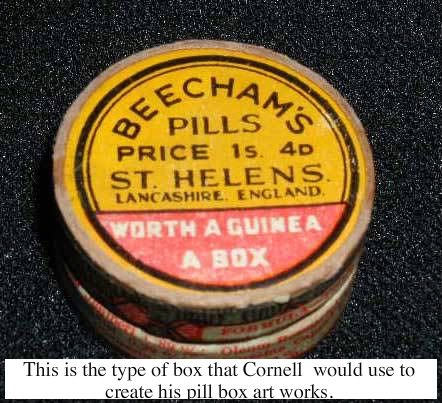
Before Joseph began making his famous shadow boxes, he experimented with small paperboard pill boxes. Cornell would buy pill boxes similar to the one in the picture, empty out their contents, and refill them with "tiny shells, sequins, red ground glass, rhinestones, beads, black thread, scraps of blue paper", and other bits of ephemera. It is unlikely that Cornell used any of the medicines that came in the boxes, as Christian Science preaches against the use of medicine. Cornell made other works that explored his interest in spiritual healing. His pharmacy boxes included small bottles filled with the same type of items that he put into his pill boxes. Could Cornell have been trying to find a spiritual cure through his art?


Sources:
3. God’s infinite goodness, realized in prayer and action, heals
Before Joseph began making his famous shadow boxes, he experimented with small paperboard pill boxes. Cornell would buy pill boxes similar to the one in the picture, empty out their contents, and refill them with "tiny shells, sequins, red ground glass, rhinestones, beads, black thread, scraps of blue paper", and other bits of ephemera. It is unlikely that Cornell used any of the medicines that came in the boxes, as Christian Science preaches against the use of medicine. Cornell made other works that explored his interest in spiritual healing. His pharmacy boxes included small bottles filled with the same type of items that he put into his pill boxes. Could Cornell have been trying to find a spiritual cure through his art?

Sources:
- Bye... My Life: The Pop Culture Shrine and Depository for Needful Things
- Utopia Parkway: The Life and Work of Joseph Cornell by Deborah Solomon
- Webmuseum, Paris
Tuesday, September 2, 2008
Cornell and Christian Science: Part 2
Continued from Cornell and Christian Science: Part 1
2. The true nature of each individual as a child of God is spiritual.
Christian Scientists believe that that human beings were created in the image of the God as stated in the Bible in Genesis 1:27. Christian Scientists have an interpretation of this that differs from other Christian religions. Being that they believe that God is spiritual (and not in any material form), humans, too, are purely spiritual beings. This being true, pain, disease, and other ailments as sociated with a physical body are not possible and therefore must be manifestations of a troubled mind. These ailments would, consequently, disappear if the sufferer could truly believe that the pain did not exist.
It makes sense that Cornell would be attracted to a religion that would deny the existence of the physical world. It must have been hard for Cornell to see his intelligent, kind and lively brother incapacitated with an incurable condition - Cerebral Palsy. To stumble upon a religion that not only claimed to be able to heal Robert, but that also insisted that his condition was all in the mind, must have been something that brought Cornell hope and a sense of relief.
TO BE CONTINUED...
Sources:
2. The true nature of each individual as a child of God is spiritual.
Christian Scientists believe that that human beings were created in the image of the God as stated in the Bible in Genesis 1:27. Christian Scientists have an interpretation of this that differs from other Christian religions. Being that they believe that God is spiritual (and not in any material form), humans, too, are purely spiritual beings. This being true, pain, disease, and other ailments as
sociated with a physical body are not possible and therefore must be manifestations of a troubled mind. These ailments would, consequently, disappear if the sufferer could truly believe that the pain did not exist.It makes sense that Cornell would be attracted to a religion that would deny the existence of the physical world. It must have been hard for Cornell to see his intelligent, kind and lively brother incapacitated with an incurable condition - Cerebral Palsy. To stumble upon a religion that not only claimed to be able to heal Robert, but that also insisted that his condition was all in the mind, must have been something that brought Cornell hope and a sense of relief.
TO BE CONTINUED...
Sources:
- Utopia Parkway: The Life and Work of Joseph Cornell by Deborah Solomon
- Joseph Cornell's Vision of Spiritual Order by Lindsay Blair
- Science and Health by Mary Baker Eddy
- The Church of Christ, Scientist website - http://www.tfccs.com
Sunday, August 31, 2008
Cornell and Christian Science: Part 1
In order to understand Joseph Cornell, it is necessary to understand the religion that he spent most of his life devoted to. Cornell discovered Christian Science when he was 21 because a coworker of his recommended a "practitioner" who might be able to help Cornell with the stomach problems he had been suffering from for years. This "practitioner" was not a doctor, but a Christian Science teacher. Cornell formally joined the church two years later and was an active member. He spent much of his time (to his mother's dismay) working in the Reading Room in his town of Flushing as well as teaching Sunday School classes to children.
The church follows three basic ideas including:
1. God is divine Love, Father-Mother, supreme.
The idea of a god that is both male and female incorporate likely appealed to Cornell for several reasons. Cornell was a man who was primarily interested in activities that, during his lifetime, were usually ascribed to women. Collecting, collage, and assemblage were activities that were popular for ladies during the Victorian era. It also may be important to note that Christian Science is one of the only major religions to be founded by a female. A female dominated world would make sense to a man whose life was controlled in many ways by his mother.
Cornell referred to certain women as his female doubles. He often formed attachments to actresses who either had an element of androgyny to their looks or personalities, or who played somewhat androgynous roles in films. Hedy Lamarr, for example appeared in a film wearing pants. Inspired by this image, Cornell developed an entire fantasy that involved Lamarr dressed in turn of the century men's clothing and riding a bicycle. Cornell was also enchanted with Lauren Bacall, who despite being the ultimate sex symbol in her first film, To Have and Have Not, exhibited certain masculine qualities such as a deep voice and the nickname, Slim.
Cornell's art often included androgynous imagery. His Medici boxes showing young, Renaissance era boys and girls whose genders are difficult to determine. He also created a portrait of his friend Lee Miller in which two identical images of Miller's face show her in a dress in the foreground and in a suit behind. Lee Miller also made a gender bending portrait of Cornell which shows a boat with a mast of long hair that appears to come off of his head.
 TO BE CONTINUED...
Sources:
The church follows three basic ideas including:
1. God is divine Love, Father-Mother, supreme.
The idea of a god that is both male and female incorporate likely appealed to Cornell for several reasons. Cornell was a man who was primarily interested in activities that, during his lifetime, were usually ascribed to women. Collecting, collage, and assemblage were activities that were popular for ladies during the Victorian era. It also may be important to note that Christian Science is one of the only major religions to be founded by a female. A female dominated world would make sense to a man whose life was controlled in many ways by his mother.
Cornell referred to certain women as his female doubles. He often formed attachments to actresses who either had an element of androgyny to their looks or personalities, or who played somewhat androgynous roles in films. Hedy Lamarr, for example appeared in a film wearing pants. Inspired by this image, Cornell developed an entire fantasy that involved Lamarr dressed in turn of the century men's clothing and riding a bicycle. Cornell was also enchanted with Lauren Bacall, who despite being the ultimate sex symbol in her first film, To Have and Have Not, exhibited certain masculine qualities such as a deep voice and the nickname, Slim.
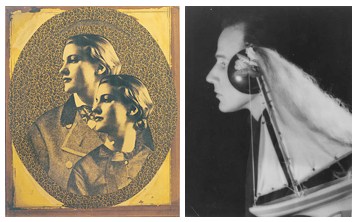
Cornell's art often included androgynous imagery. His Medici boxes showing young, Renaissance era boys and girls whose genders are difficult to determine. He also created a portrait of his friend Lee Miller in which two identical images of Miller's face show her in a dress in the foreground and in a suit behind. Lee Miller also made a gender bending portrait of Cornell which shows a boat with a mast of long hair that appears to come off of his head.
 TO BE CONTINUED...
Sources:
- Utopia Parkway: The Life and Work of Joseph Cornell by Deborah Solomon
- Joseph Cornell: Gifts of Desire by Dickran Tashjian
- Joseph Cornell's Vision of Spiritual Order by Lindsay Blair
- Science and Health by Mary Baker Eddy
- The Church of Christ, Scientist website - http://www.tfccs.com
- The Bible - http://biblegateway.com
Friday, August 8, 2008
Utopia Parkway: The Life and Work of Joseph Cornell by Deborah Solomon
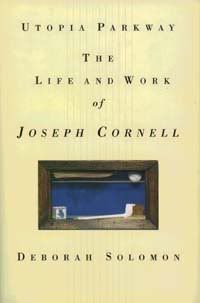
Solomon packs Utopia Parkway full of information on Cornell’s life – from before he was born, to his death. There is extensive information on his relationships with characters in the play such as: his mother, Robert, Carolee Schneeman, Leila Hadley, Allegra Kent, Marcel Duchamp, Roberto Matta, Marianne Moor, Joyce the waitress, and others. Solomon also describes Cornell’s attachment to Christian Science, an important aspect of his and Robert’s lives. A fascinating read.
Thursday, August 7, 2008
A Joseph Cornell Album by Dore Ashton

A Joseph Cornell Album is aptly named, as it is indeed an album that contains a collection of items that may be of interest to someone researching Cornell. The most interesting parts of this book include Cornell’s Recommended Readings which are excerpts from books, journals, memoirs, sermons, and poems that inspired Cornell. Conversely, there is a section on work that was inspired BY Cornell, such as the poems “Objects and Apparitions” by Octavio Paz, “Pantoum” by John Ashberry, and “The Crystal Cage” by Stanley Kunitz. There are also some charming pictures of Cornell as an older man – with his art, at his home, and with children at an exhibition.
Tuesday, August 5, 2008
Joseph Cornell: Master of Dreams by Diane Waldman

The author, Diane Waldman, became friends with Cornell in 1963 while doing research for her MFA thesis on Cornell’s work. She is one of the first people to study Cornell’s art academically and her deep understanding of his work is evident in the book. This book focuses less on Cornell’s life and more on his art. This is a gorgeous book – well designed with huge, colorful pictures.
Joseph Cornell: Stargazing in the Cinema by Jodi Hauptman
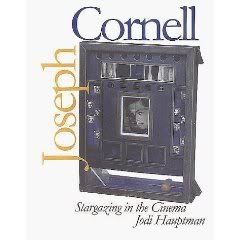
Hauptman delves into Cornell’s fear of the female body and his obsession with innocence and purity. The most interesting and informative chapters include: Chapter Two which focuses entirely on Cornell’s The Penny Arcade Portrait of Lauren Bacall and the actress that inspired the work; Chapter Three which describes Cornell’s films; and Chapter six which explores Cornell’s interest in the imaginary girl Berenice that Cornell idealized for her purity and the real life girls that Cornell imagined to be the real life Bernenice.
Subscribe to:
Posts (Atom)
