Showing posts with label Key Terms. Show all posts

Friday, September 12, 2008

Key Terms: Surrealism

One of the most well-known and popular Surrealist artists is Salvador Dali. Most college students would recognize his painting "Persisitence of Memory" (although they may only know it as "the one with the melting clocks.") One night, when Joseph Cornell was screening one of his collage films, Dali flew into a jealous rage, overturned the projector, and called Cornell a skunk. Dali later said, "My idea for a film is exactly that... I never wrote it or told anyone, but it is as if he had stolen it." While Joseph Cornell was never a card-carrying member of the Surrealist movement, Surrealism did provide a context in which his art was accepted and understood.

The founder of Surrealism, André Breton, defined Surrealism as "Pure psychic automatism, by which it is intended to express, verbally, in writing, or by other means, the real process of thought. Thought's dictation, in the absence of all control exercised by the reason and outside all aesthetic or moral preoccupations... Surrealism rests in the belief in the superiorreality of certain forms of association neglected heretofore; in the omnipotence of the dream and in the disinterested play of thought. It tends definitely to do away with all other psychic mechanisms and to substitute itself for them in the solution of the principal problems of life."

In other words, surrealists:
  • Strive to allow the impulses of the unconscious mind to guide the production of their art
  • Believe in Freud's idea of analyzing dreams to explore the subconscious
  • Strip images of their meaning and allow the unconscious to assign them a new meaning
Joseph Cornell was first inspired by the work of surrealist, Max Ernst. Cornell began making collages that were similar to Ernsts. After he developed his own style of art - his famous shadowboxes - Cornell exhibited his work with Surrealists and became friends with many of them. Cornell's work was dreamlike and certainly used images to evoke feelings from his subconscious, however, he never truly fit into the Surrealist mold. He was a "mama's boy who spent his Sundays in church and quavered before visions of fleshly sin." Many aspects of Surrealism such as "their call for revolution, their hatred of the church, their furious loathing of the parental generation... made him a most improbable disciple." Cornell once said that he felt Surrealism, "has healthier possibilities than have been developed."


Sources:
  • Utopia Parkway: The Life and work of Joseph Cornell by Deborah Solomon
  • Manifestoes of Surrealism by André Breton
  • Giornal Nuovo

Sunday, September 7, 2008

Cornell and Christian Science: Part 3

Continued from Cornell and Christian Science: Part 2

3. God’s infinite goodness, realized in prayer and action, heals

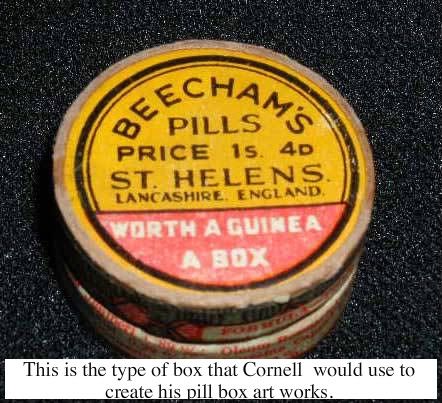
Before Joseph began making his famous shadow boxes, he experimented with small paperboard pill boxes. Cornell would buy pill boxes similar to the one in the picture, empty out their contents, and refill them with "tiny shells, sequins, red ground glass, rhinestones, beads, black thread, scraps of blue paper", and other bits of ephemera. It is unlikely that Cornell used any of the medicines that came in the boxes, as Christian Science preaches against the use of medicine. Cornell made other works that explored his interest in spiritual healing. His pharmacy boxes included small bottles filled with the same type of items that he put into his pill boxes. Could Cornell have been trying to find a spiritual cure through his art?


Sources:

Tuesday, September 2, 2008

Cornell and Christian Science: Part 2

Continued from Cornell and Christian Science: Part 1

2. The true nature of each individual as a child of God is spiritual
.

Christian Scientists believe that that human beings were created in the image of the God as stated in the Bible in Genesis 1:27. Christian Scientists have an interpretation of this that differs from other Christian religions. Being that they believe that God is spiritual (and not in any material form), humans, too, are purely spiritual beings. This being true, pain, disease, and other ailments associated with a physical body are not possible and therefore must be manifestations of a troubled mind. These ailments would, consequently, disappear if the sufferer could truly believe that the pain did not exist.

It makes sense that Cornell would be attracted to a religion that would deny the existence of the physical world. It must have been hard for Cornell to see his intelligent, kind and lively brother incapacitated with an incurable condition - Cerebral Palsy. To stumble upon a religion that not only claimed to be able to heal Robert, but that also insisted that his condition was all in the mind, must have been something that brought Cornell hope and a sense of relief.


TO BE CONTINUED...

Sources:
  1. Utopia Parkway: The Life and Work of Joseph Cornell by Deborah Solomon
  2. Joseph Cornell's Vision of Spiritual Order by Lindsay Blair
  3. Science and Health by Mary Baker Eddy
  4. The Church of Christ, Scientist website - http://www.tfccs.com

Sunday, August 31, 2008

Cornell and Christian Science: Part 1

In order to understand Joseph Cornell, it is necessary to understand the religion that he spent most of his life devoted to. Cornell discovered Christian Science when he was 21 because a coworker of his recommended a "practitioner" who might be able to help Cornell with the stomach problems he had been suffering from for years. This "practitioner" was not a doctor, but a Christian Science teacher. Cornell formally joined the church two years later and was an active member. He spent much of his time (to his mother's dismay) working in the Reading Room in his town of Flushing as well as teaching Sunday School classes to children.

The church follows three basic ideas including:

1. God is divine Love, Father-Mother, supreme.


The idea of a god that is both male and female incorporate likely appealed to C
ornell for several reasons. Cornell was a man who was primarily interested in activities that, during his lifetime, were usually ascribed to women. Collecting, collage, and assemblage were activities that were popular for ladies during the Victorian era. It also may be important to note that Christian Science is one of the only major religions to be founded by a female. A female dominated world would make sense to a man whose life was controlled in many ways by his mother.

Cornell referred to certain women as his female d
oubles. He often formed attachments to actresses who either had an element of androgyny to their looks or personalities, or who played somewhat androgynous roles in films. Hedy Lamarr, for example appeared in a film wearing pants. Inspired by this image, Cornell developed an entire fantasy that involved Lamarr dressed in turn of the century men's clothing and riding a bicycle. Cornell was also enchanted with Lauren Bacall, who despite being the ultimate sex symbol in her first film, To Have and Have Not, exhibited certain masculine qualities such as a deep voice and the nickname, Slim.

Cornell's art often included androgynous imagery. His Medici boxes showing young,
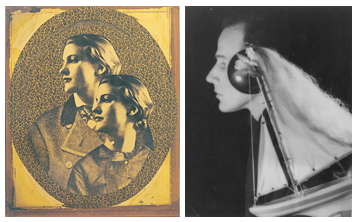
Renaissance era boys and girls whose genders are difficult to determine. He also created a portrait of his friend Lee Miller in which two identical images of Miller's face show her in a dress in the foreground and in a suit behind. Lee Miller also made a gender bending portrait of Cornell which shows a boat with a mast of long hair that appears to come off of his head.

TO BE CONTINUED...

Sources:
  1. Utopia Parkway: The Life and Work of Joseph Cornell by Deborah Solomon
  2. Joseph Cornell: Gifts of Desire by Dickran Tashjian
  3. Joseph Cornell's Vision of Spiritual Order by Lindsay Blair
  4. Science and Health by Mary Baker Eddy
  5. The Church of Christ, Scientist website - http://www.tfccs.com
  6. The Bible - http://biblegateway.com


Monday, August 25, 2008

Key Terms: "Huntley and Palmer Shortcake Cookies"

The "Huntley and Palmer shortcake cookies" that Joseph refers to in Scene 1 are probably the Iced Gems that Huntley and Palmers, and English biscuit company began producing in 1910. These little cookies are still produced today by Jacob's Bakery Ltd. and have a small cult following. Anyone need some cookie shaped cuff links or earrings?

For more info...
The Huntley and Palmers Collection
Ritz Food Product Corporation
Nice Cup of Tea and Sit Down Dot Com

Sunday, August 24, 2008

Key Terms: Automat


The automat is a self-service cafeteria which keeps its food selections in small compartments that are opened when the customer inserts money into a slot adjacent to the compartment. Automats were popular in New York City during the first half of the century as a place to get an inexpensive, hot meal. They had kitchens with chefs that would make the food, but costs were kept down by the decreased need for waiters and waitresses. The automats of Cornell's time would have had one or two waitresses to make change (the automat machines took nickels.) The rise of the fast food restaurant virtually killed the automats, however with the demand for higher quality food at low prices, they may make a comeback. New York City currently has an automat in operation called Bamn!

Here is a video about Bamn!


Here's a short clip of an automat.

For more information on automats, check out these websites and articles:


Watch these films to see scenes set in automats: