Showing posts with label book. Show all posts

Thursday, September 25, 2008

Another quote form Charles Mee

Charles Mee was a carefree, athletic teenager when he was struck with polio in 1953. His memoir, A Nearly Normal Life, reveals how this horrible disease changed his life. In the following quote Mee explains how surviving polio shaped his writing style.

"I find, when I write, that I really don't want to write well-made sentences and paragraphs, narratives that flow, structures that have a sense of wholeness and balance, books that feel intact. Intact people should write intact books with sound narratives built of sound paragraphs that unfold with a sense of dependable cause and effect, solid structures you can rely on. That is not my experience of the world. I like a book that feels like a crystal goblet that has been thrown to the floor and shattered, so that its pieces, when they are picked up and arranged on a table, still describe a whole glass, but the glass itself lies in shards. To me, sentences should veer and smash up, careen out of control; get under way and find themselves unable to stop, switch directions suddenly and irrevocably, break off, come to a sighing, inconslusiveness. If a writer's writings constitute a "body of work," then my body of work, to feel true to me, must feel fragmented. And then, too, if you find it hard to walk down the sidewalk, you like, in the freedom of your mind, to make a sentence that leaps and dances now and then before it comes to a sudden stop."

Friday, August 8, 2008

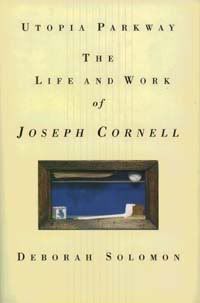
Utopia Parkway: The Life and Work of Joseph Cornell by Deborah Solomon


Solomon packs Utopia Parkway full of information on Cornell’s life – from before he was born, to his death. There is extensive information on his relationships with characters in the play such as: his mother, Robert, Carolee Schneeman, Leila Hadley, Allegra Kent, Marcel Duchamp, Roberto Matta, Marianne Moor, Joyce the waitress, and others. Solomon also describes Cornell’s attachment to Christian Science, an important aspect of his and Robert’s lives. A fascinating read.

Thursday, August 7, 2008

A Joseph Cornell Album by Dore Ashton


A Joseph Cornell Album is aptly named, as it is indeed an album that contains a collection of items that may be of interest to someone researching Cornell. The most interesting parts of this book include Cornell’s Recommended Readings which are excerpts from books, journals, memoirs, sermons, and poems that inspired Cornell. Conversely, there is a section on work that was inspired BY Cornell, such as the poems “Objects and Apparitions” by Octavio Paz, “Pantoum” by John Ashberry, and “The Crystal Cage” by Stanley Kunitz. There are also some charming pictures of Cornell as an older man – with his art, at his home, and with children at an exhibition.

Tuesday, August 5, 2008

Joseph Cornell: Master of Dreams by Diane Waldman


The author, Diane Waldman, became friends with Cornell in 1963 while doing research for her MFA thesis on Cornell’s work. She is one of the first people to study Cornell’s art academically and her deep understanding of his work is evident in the book. This book focuses less on Cornell’s life and more on his art. This is a gorgeous book – well designed with huge, colorful pictures.

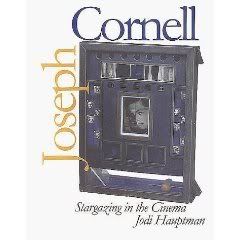
Joseph Cornell: Stargazing in the Cinema by Jodi Hauptman


Hauptman delves into Cornell’s fear of the female body and his obsession with innocence and purity. The most interesting and informative chapters include: Chapter Two which focuses entirely on Cornell’s The Penny Arcade Portrait of Lauren Bacall and the actress that inspired the work; Chapter Three which describes Cornell’s films; and Chapter six which explores Cornell’s interest in the imaginary girl Berenice that Cornell idealized for her purity and the real life girls that Cornell imagined to be the real life Bernenice.

Joseph Cornell: Gifts of Desire by Dickran Tashjian


Tashjian focuses on Cornell’s passion for gifts. As a child Cornell loved Christmas and thus associated the act of gift giving with the happiest times in his life. Tashjian explores the motivations behind the creation of the gifts and tributes that Cornell created. There is a strong emphasis on the androgynous imagery in Cornell’s work as well as Cornell’s desire to connect with his feminine side.